Tommy Giberson
"audio engineer"
I am a Sound Engineering graduate with a minor in Electrical Engineering from the University of Michigan. I work for the Rackham Graduate School in the Facilities Office as an Events Specialist, Audio Visual Lead. I have a diverse experience set with audio/visual technology: studio recording and engineering, location recording, mixing and mastering, as well as professional experience with commercial audio/visual technology such as Crestron and Q-SYS.
Please feel free to reach out! You can find my professional resume here.
Creative
Academic
Selected Chamber Orchestra Recordings
I assisted friends and other students with recording and post production of several audition reels, recitals, etc. throughout my time as a student. This was primarily done in Studios A and B at the Duderstadt Center at the University of Michigan as well as recital halls across North Campus such as Britton Recital Hall.
Mendelssohn: String Quartet No.3 in D major
Excerpt from Senior Recital
Excerpt from Audition Reel
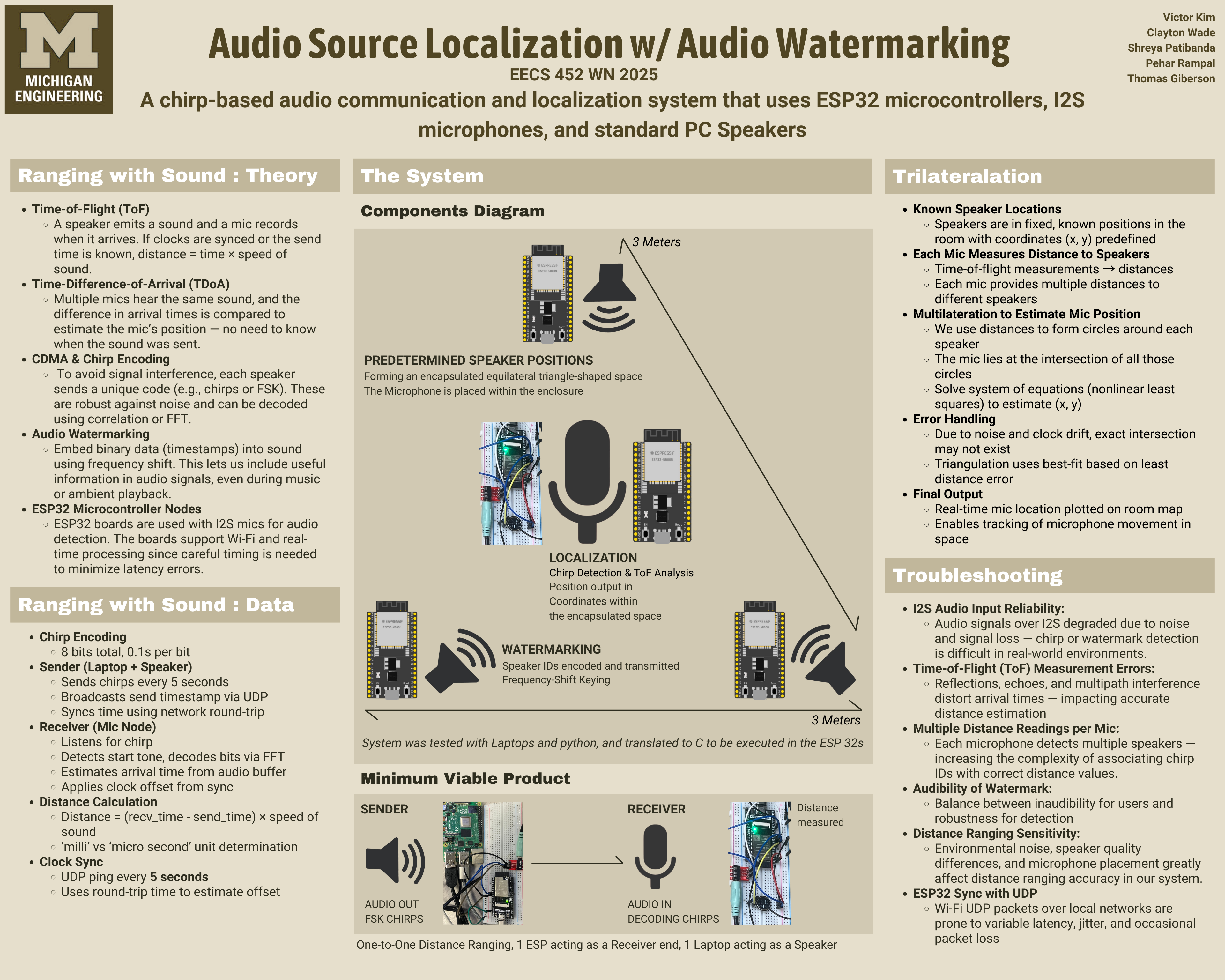
Audio Watermarking and Source Localization
EECS 452: DSP Design Lab
April 2026
My partners and I designed a system implemented using ESP32s as a demonstration of Time of Flight (ToF) calculation using audio signals to determine the distance between two individual devices. The use of audio would also allow for messages to be sent via watermarking the audio using convolution.
Outboard EQ and Preamp Simulation
EECS 351: Introduction to Digital Signal Processing
November 2025
My project team and I took measurements and recordings of the outboard audio effects that are available in the audio studios at the Duderstadt Center at the University of Michigan, then used these recordings to create digital filters in MATLAB that can then be applied to an incoming audio signal that simulates the effect the physical equipment would have on that same signal.
Contact
Rackham
rackham.umich.eduResume
Download PDF